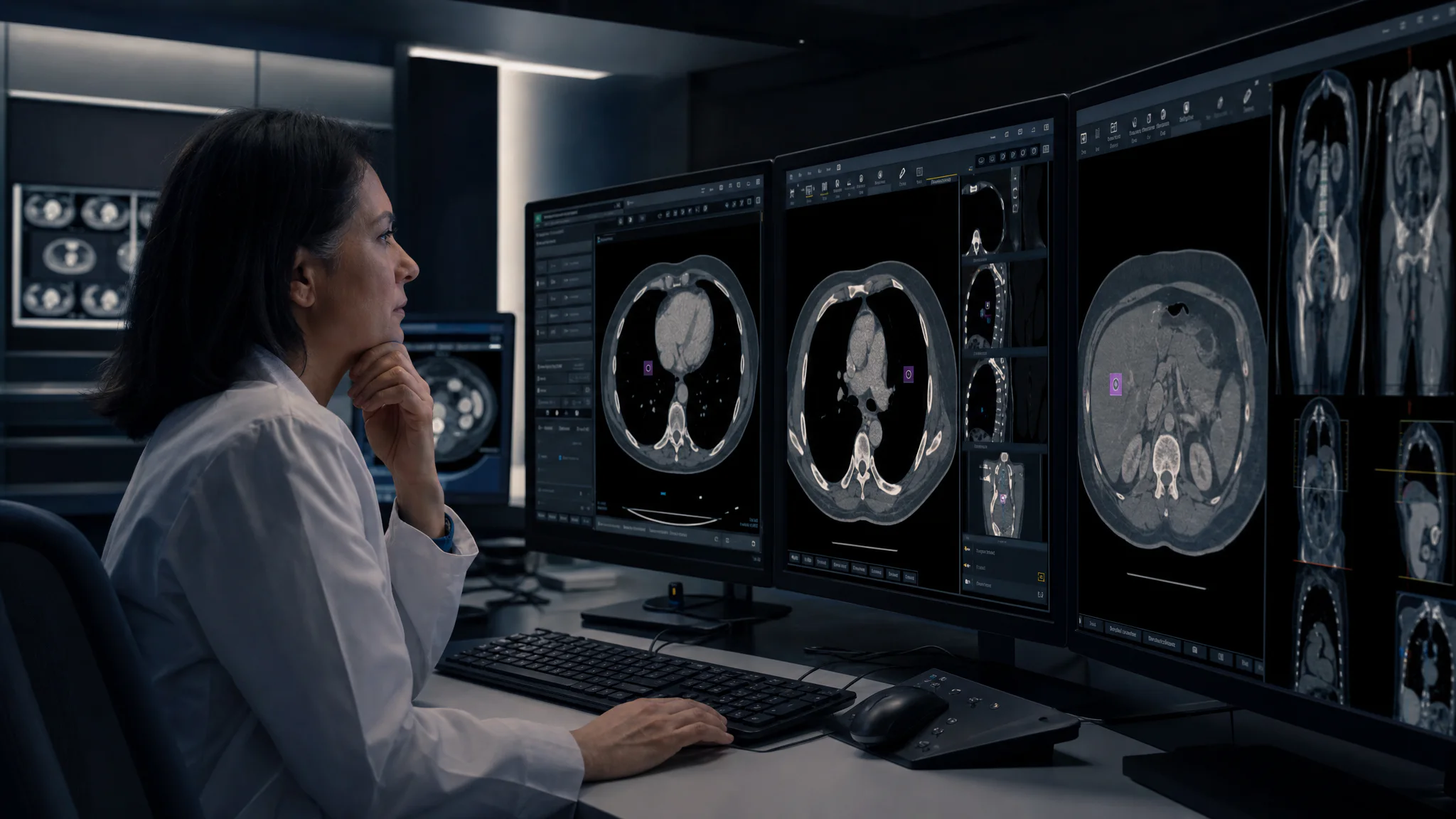
In 2023, 38% of US physicians said they used AI in their work. In 2024 it was 66%. In the American Medical Association's 2026 survey, the number reached 81% — with the average physician using AI for more than two distinct tasks.
That's not a hype curve. That's infrastructure being installed. Here's where the adoption actually is — with numbers — and what it means if you run a hospital, clinic, or health-tech company.
The adoption curve
Physicians using AI in their work
The adoption picture in numbers
- 81%
- of US physicians use AI professionally
- 1,524
- FDA-cleared AI medical devices
- 62.6%
- of Epic hospitals run ambient AI documentation
- ~$50B
- healthcare AI market, growing ~40% a year
AMA survey, 2026
FDA list, March 2026
Industry tracking, June 2025
Consensus of 2026 market reports
Ambient documentation: the killer app nobody predicted
The single biggest AI deployment in medicine isn't diagnostic at all. It's the ambient scribe — AI that listens to the patient visit and drafts the clinical note straight into the EHR.
By mid-2025, 62.6% of hospitals on Epic had adopted ambient documentation; by 2026 it's simply table stakes. The market splits roughly three ways:
- Nuance DAX Copilot (Microsoft) — about a third of the market, present in some form across three-quarters of US hospitals, with the deepest Epic integration.
- Abridge — roughly 30% share, live in 250+ health systems including Kaiser Permanente (~25,000 physicians across 40 hospitals), Mayo Clinic, Johns Hopkins, and Duke, across 50+ specialties and 14+ languages.
- Ambience Healthcare — around 13%, growing fast in specialty workflows.
Ambient scribe market
Who drafts the notes: approximate US market share, 2026
- Nuance DAX Copilot~33%
- Abridge~30%
- Ambience~13%
- Everyone else~24%
Why it won: documentation is the top driver of clinician burnout, the ROI is measured in hours per clinician per week, and — critically — drafting notes for human review isn't a regulated medical device function, so deployment doesn't wait on FDA clearance.
The strategic lesson for anyone building in this space: the fastest path to production AI in healthcare runs through administrative pain, not diagnostic glory.
Radiology: three-quarters of all cleared medical AI
Radiology has been the proving ground for regulated clinical AI for a decade, and it shows: 1,163 of the 1,524 FDA-cleared AI devices — 76% — are radiology tools, with roughly 30 new clearances a month and 68 in Q1 2026 alone.
FDA-cleared AI devices by specialty
- Radiology1,163
- All other specialties361
In production today, these systems:
- Flag time-critical findings (intracranial hemorrhage, pulmonary embolism, stroke) and re-order the reading worklist in seconds
- Detect and measure lesions, nodules, and fractures as a second reader
- Draft preliminary structured reports for radiologist sign-off
- Run multi-condition screening from a single CT — the January 2026 Aidoc clearance covers multiple pathologies in one pass
The friction point is money, not accuracy: very few of these tools have dedicated reimbursement codes, so business cases lean on throughput and quality rather than new revenue. Watch this space — it's the sector's loudest policy fight.
Prediction: sepsis, deterioration, and the lessons of v1
Hospitals increasingly run machine-learning models over live vitals, labs, and nursing notes to catch deterioration early. Done well, it works: Virtua Health's custom XGBoost sepsis model predicts onset up to 4 hours in advance with materially fewer false alarms than the commercial tools it replaced.
The cautionary tale is Epic's original proprietary sepsis model, which a famous 2021 external validation found badly underperforming its marketing. The industry learned the right lesson: externally validate, or don't deploy. The 2026 pattern is custom or transparently-validated models, tuned per institution, surfaced inside existing clinical workflows.
The platform layer: Epic, Microsoft, and Cosmos
The most consequential AI moves in healthcare aren't apps — they're platforms.
Epic runs its generative features on Azure OpenAI under HIPAA-compliant infrastructure, and at Microsoft Ignite 2025 the two companies unveiled AI charting, revenue-cycle assistants, and autonomous agents on the Dragon Copilot platform for prior authorization, insurance forms, and no-show prediction.
The deeper play is Cosmos: Epic's de-identified dataset covering 300M+ patients and over a trillion data points. CoMET — a "medical event transformer" foundation model built with Microsoft and Yale — simulates patient trajectories to predict future risk. When risk prediction ships as a platform feature inside the EHR your hospital already runs, adoption stops being a procurement decision and becomes a checkbox.
Drug discovery: from structure prediction to human trials
AlphaFold 3 (2024) extended structure prediction to protein–drug interactions, and Isomorphic Labs — DeepMind's drug-design spinout — raised $600M in 2025 with partnerships at Novartis and Eli Lilly. Its first AI-designed molecules are expected to enter human trials around the end of 2026, and its February 2026 IsoDDE drug-design engine claims more than double AlphaFold 3's accuracy on the hardest interaction classes.
For hospital systems this is background radiation — but for anyone in pharma-adjacent tech, the message is that AI-first pipelines are now competing directly with traditional discovery.
Triage and patient-facing AI
Symptom checkers grew up. Ada Health, Infermedica (whose Conversational Triage pairs an LLM with a Bayesian medical knowledge graph), and K Health now route real patient volume to the right level of care, and the NHS is piloting AI triage across primary-care intake.
One regulatory wrinkle to design for: under California's AB 3030, AI-generated clinical communications to patients must disclose their AI origin unless a human clinician reviews them first — a template for disclosure rules spreading across other states.
What's overhyped (a short honest list)
- Autonomous diagnosis without a clinician in the loop. Aside from narrow cleared cases like diabetic-retinopathy screening, nobody serious ships this — and the liability framework doesn't support it.
- "AI will replace radiologists." A decade of predictions later, radiology has a workforce shortage and the most AI. The tools amplify throughput; they don't replace judgment.
- General chatbots as medical advisors. The AMA's own survey shows physician trust remains "lukewarm" — the wins are in scoped, validated, workflow-embedded tools.
What this means if you're deciding right now
- Start where the money already flows: documentation and administrative automation deploy in weeks and pay for the harder projects.
- Insist on external validation for anything predictive — your patient population is not the vendor's training set.
- Plan for the platform layer: if it ships inside Epic/your EHR tomorrow, don't build a standalone version of it today. Build what the platforms won't: your specialty's workflow, your data advantage.
- Design disclosure and human review in from day one — regulation is converging on both.
The 81% isn't the story. The story is that the remaining work — integration, validation, governance — is now the whole game.