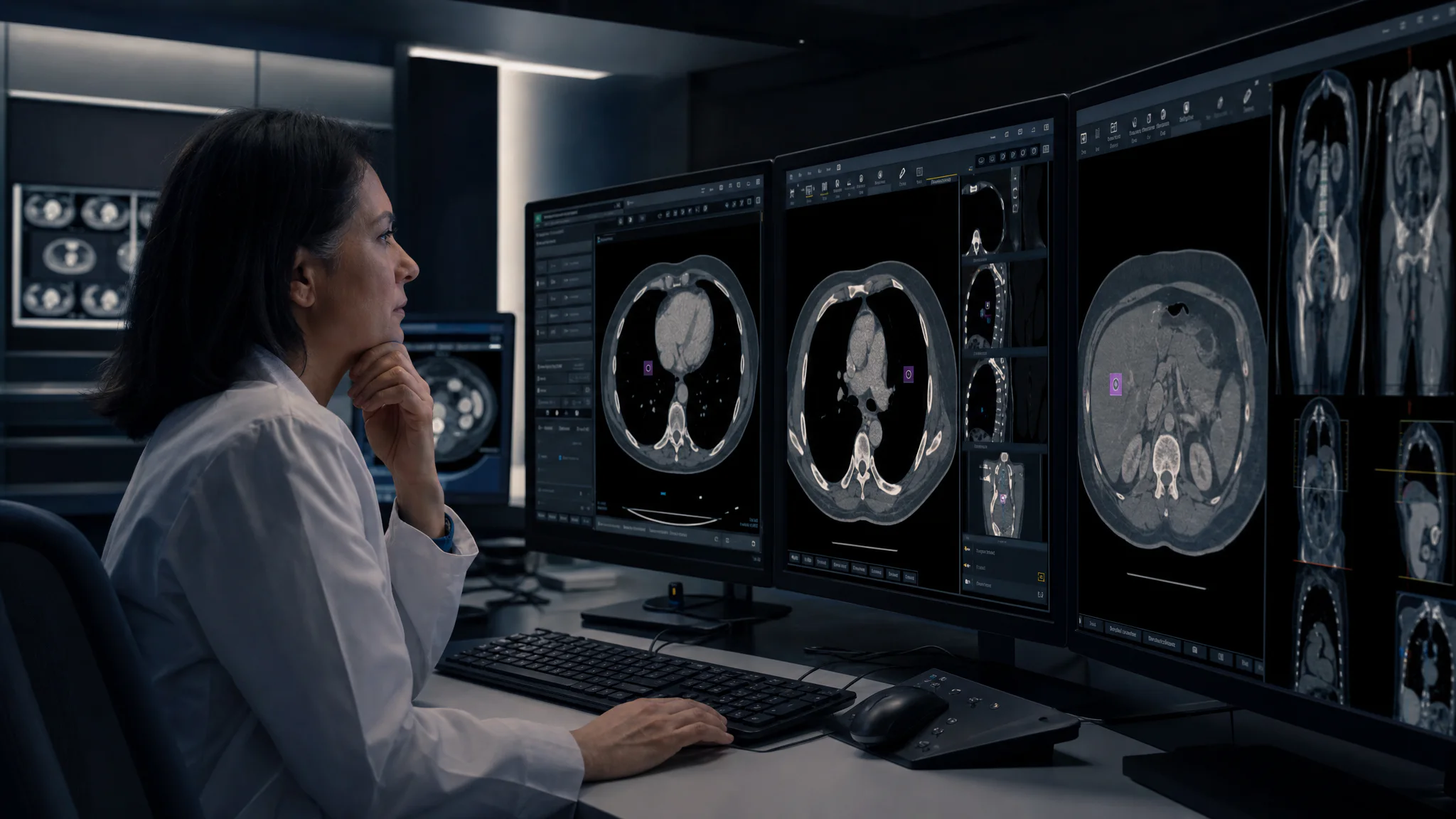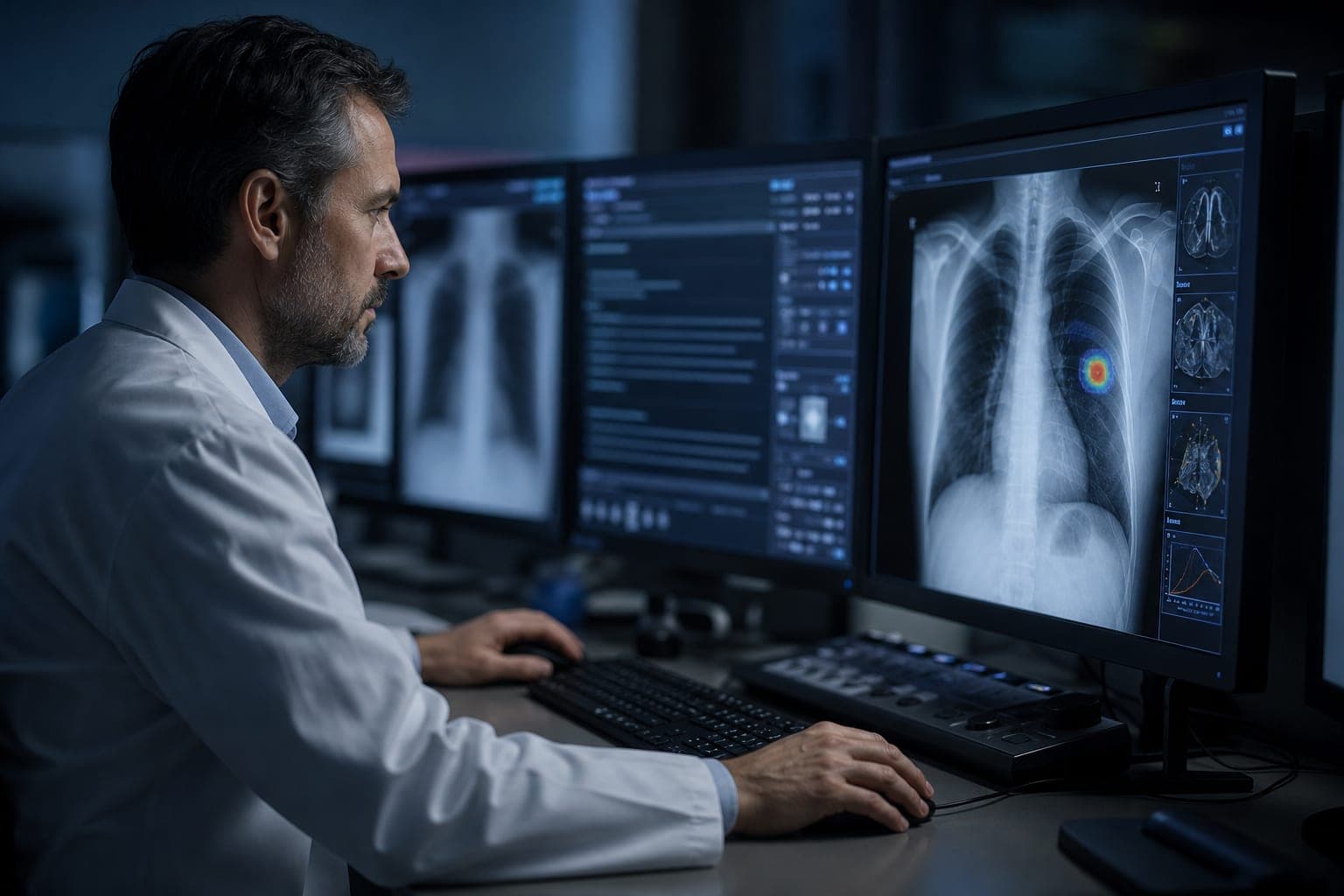
The conversation about medical AI changed in 2025 when OpenAI released its first open-weight models — and again in January 2026 when Google shipped MedGemma 1.5. For the first time, hospitals and health-tech companies can run genuinely frontier-class models on their own hardware, where patient data never leaves the building.
This guide covers the open-source and open-weight LLMs that actually matter for medical diagnosis in mid-2026 — what they score, what they cost to run, how they're licensed, and how to choose between them.
Who this is for: CTOs, clinical informatics leads, and founders evaluating models for diagnostic support, medical Q&A, imaging interpretation, or clinical documentation — anywhere data governance rules out consumer AI APIs.
Why open-source models for medical diagnosis?
Three forces push medical teams toward open weights:
1. Privacy and compliance. Any cloud LLM that touches protected health information needs a HIPAA Business Associate Agreement (in the US) or equivalent safeguards under PIPEDA/PHIPA (in Canada). Self-hosting an open-weight model sidesteps the problem entirely: PHI stays inside your network perimeter.
2. Auditability. Diagnosis is a regulated, high-stakes domain. With open weights you can freeze a model version, validate it against your own patient population, document its behavior for regulators, and guarantee it won't silently change under you — something no API vendor will promise.
3. Economics at scale. Inference on your own GPUs is dramatically cheaper at hospital volumes than per-token API pricing, and models like gpt-oss-120b were explicitly engineered to fit on a single 80 GB GPU.
How models are actually evaluated in 2026
A warning before the leaderboard: MedQA is saturated. The classic multiple-choice benchmark (USMLE-style questions) now sees frontier models scoring 90%+, which makes it nearly useless for separating serious contenders.
The field has moved to HealthBench — released by OpenAI in May 2025 and built from 5,000 physician-written, multi-turn health conversations across 26 topics, graded against physician rubrics. It measures what actually matters in practice: safe, complete, context-aware answers, not test-taking.
When a vendor quotes only MedQA, ask why. Precision about benchmarks is the fastest way to separate marketing from engineering.
The 2026 open-model leaderboard at a glance
| Model | Params | License | Key medical score | Multimodal | Runs on |
|---|---|---|---|---|---|
 MedGemma 1.5 (Google) MedGemma 1.5 (Google) | 4B | HAI-DEF open-weight | MedQA 69.1% (4B); 27B v1 hits 85.3% | Yes — X-ray, CT, MRI, pathology | Laptop / edge / single GPU |
 gpt-oss-120b (OpenAI) gpt-oss-120b (OpenAI) | 117B MoE (5.1B active) | Apache 2.0 | HealthBench 0.576 | No (text) | Single 80 GB GPU |
| gpt-oss-20b (OpenAI) | 20B MoE | Apache 2.0 | HealthBench 0.425 | No (text) | 16 GB VRAM |
 Baichuan-M2-32B Baichuan-M2-32B | 32.8B | Apache 2.0 | HealthBench 60.1 (self-reported) | No (text) | 1–2 GPUs |
 DeepSeek-R1 (0528) DeepSeek-R1 (0528) | 671B MoE | MIT | ~93% on MedQA subsets in studies | No (text) | Multi-GPU cluster |
 Kimi K2-Thinking Kimi K2-Thinking | 1T-class MoE | Modified MIT | HealthBench 0.580 (top of public board) | No (text) | Cluster / hosted |
 GLM-4.5V (Zhipu) GLM-4.5V (Zhipu) | 106B MoE (12B active) | Open weights | SOTA on 41 multimodal benchmarks | Yes — vision-language | 1–2 GPUs |
Sources: HealthBench public leaderboard (llm-stats.com, July 2026), Google HAI-DEF model cards, Baichuan-M2 technical report (arXiv 2509.02208).
The benchmark that matters
HealthBench — physician-graded health conversations (0–1)
MedGemma 1.5 — the medical specialist
Google's MedGemma is the only major open release purpose-built for medicine, and the January 2026 v1.5 release made it genuinely multimodal for clinical work.
What sets it apart:
- Reads medical images natively. Chest X-rays, CT and MRI volumes, whole-slide histopathology, dermatology photos, retinal fundus images — via a SigLIP encoder pretrained on de-identified medical imaging.
- Handles longitudinal records. v1.5 added serial X-ray comparison and EHR/document extraction (89.6% on EHRQA; 91.0 macro-F1 turning lab reports into structured JSON).
- Small enough to deploy anywhere. The 4B model runs on a single workstation GPU — or at the edge inside a clinic with no cloud connection at all.
Benchmark reality check: the widely-quoted "~91% MedQA, beats Med-PaLM 2" figure belongs to the 27B v1 tier (85.3% officially). The current 4B v1.5 scores 69.1% on MedQA — outstanding for its size, but don't conflate the tiers. On imaging tasks, v1.5's gains are dramatic: whole-slide pathology description jumped from a 2.2 to 49.4 ROUGE score, and chest X-ray localization IoU from 3.1 to 38.0.
MedGemma v1 → v1.5
What one point release did to medical imaging
- 2.2 → 49.4
- Whole-slide pathology description
- 3.1 → 38.0
- Chest X-ray localization
- 89.6%
- EHR question answering
- 91.0
- Lab reports → structured JSON
ROUGE score
IoU
EHRQA benchmark
macro-F1
License note: MedGemma ships under Google's Health AI Developer Foundations terms — open-weight but not Apache. Review the terms before redistributing it inside a commercial product.
gpt-oss-120b — the deployable frontier reasoner
OpenAI's August 2025 release of gpt-oss-120b was the first time a frontier lab shipped open weights that top health benchmarks — under a clean Apache 2.0 license.
- HealthBench 0.576, HealthBench Hard 0.300 — the strongest broadly-licensed open model on physician-graded health conversations, near o4-mini-level reasoning.
- Engineered for one GPU. The mixture-of-experts design activates only 5.1B parameters per token and ships in MXFP4 quantization, fitting a single 80 GB card (H100/A100-class).
- Its sibling gpt-oss-20b (HealthBench 0.425) runs in 16 GB of VRAM — enough for a pilot on a high-end workstation.
For text-based diagnostic support, triage reasoning, and clinical Q&A where you need strong general intelligence plus health competence, this is the default open choice in 2026.
Baichuan-M2-32B — the medical-tuned challenger
Released September 2025 on a Qwen2.5-32B base, Baichuan-M2 was trained with a novel "Large Verifier System" — reinforcement learning against real-world medical questions with physician-designed verification.
- HealthBench 60.1 and HealthBench Hard above 32 (self-reported) — the paper claims it beat every open model and most closed ones at release, second only to GPT-5.
- At 32.8B parameters it deploys on one or two GPUs, making it the strongest medical-specialized text model per dollar of hardware.
Honest caveat: the headline scores are self-reported and not yet reproduced on the independent public leaderboard. Validate on your own cases before committing — true of every model here, but doubly so for self-reported numbers.
DeepSeek-R1 — auditable reasoning, with caveats
DeepSeek-R1 (MIT license, 671B MoE) brought full chain-of-thought reasoning to open weights. For medicine, that transparency is the draw: clinicians can read why the model reached a differential, not just the answer.
Published evaluations show ~93% on MedQA-style question sets. But studies also documented characteristic failure modes worth designing around:
- Anchoring bias — over-committing to an early hypothesis
- Overthinking — long reasoning chains that talk themselves out of correct answers
- Narrow differentials — missing less-common diagnoses
R1 works best paired with retrieval over your own clinical guidelines and a human-review workflow, not as a standalone oracle. Its size also means real infrastructure — this is a cluster deployment, not a workstation one.
The multimodal contenders: GLM-4.5V and Kimi K2
GLM-4.5V (Zhipu AI, 106B MoE) is the strongest open vision-language generalist — state-of-the-art on 41 multimodal benchmarks at release, with a "Thinking Mode" for stepwise visual reasoning. It isn't medical-tuned, but teams use it where MedGemma's 4B capacity isn't enough for complex mixed image-text reasoning.
Kimi K2-Thinking (Moonshot) actually tops the public HealthBench board at 0.580 — a hair above gpt-oss-120b. It's a trillion-parameter-class system, so most teams touch it through hosted inference rather than self-deployment, which reintroduces the data-governance question open weights were meant to solve.
What happened to the small medical fine-tunes?
Meditron, OpenBioLLM, BioMistral, PMC-LLaMA — the 2023–2024 wave of 7B–70B medical fine-tunes — have largely been overtaken by frontier generalists and large reasoning models. A 2026 fully-open Meditron replication put it plainly: the small medical specialists now trail even general-purpose Qwen2.5-32B on aggregate medical benchmarks.
They still matter in two niches: fully-auditable pipelines where every training token must be documented (the "Fully Open Meditron" effort), and severely resource-constrained deployments (II-Medical's 8B reasoning model punches far above its weight). But if you're starting fresh in 2026, start with the table above.
Licensing: the sidebar that decides architectures
| License | Models | Commercial use | Redistribution | Gotchas |
|---|---|---|---|---|
| Apache 2.0 | gpt-oss-120b/20b, Baichuan-M2 | Yes | Yes | Cleanest option for products |
| MIT | DeepSeek-R1 | Yes | Yes | Minimal restrictions |
| HAI-DEF terms | MedGemma family | Yes, with terms | Restricted | Read before embedding in a device |
| Llama license |  Meditron-3, OpenBioLLM Meditron-3, OpenBioLLM | Yes, with limits | With conditions | User-count and naming clauses |
If your model becomes part of an FDA- or Health Canada-regulated device, the license also has to survive your regulatory documentation and change-control plan. Apache 2.0 and MIT make that conversation short.
How to choose: a practical decision guide
- Medical imaging + text (X-ray, CT, pathology, EHR): MedGemma 1.5. Nothing else open comes close on medical multimodality per parameter.
- Best text-based clinical reasoning you can self-host: gpt-oss-120b on one 80 GB GPU; Baichuan-M2-32B if you want a medical-tuned alternative on lighter hardware.
- Pilot on a workstation budget: gpt-oss-20b or MedGemma 4B — both run on hardware your IT department already owns.
- Transparent reasoning for clinician review: DeepSeek-R1 with retrieval, inside a human-in-the-loop workflow.
- Complex visual reasoning beyond medical presets: GLM-4.5V.
Whatever you pick: benchmark on your own data. Published scores are entry criteria, not deployment evidence. A model that tops HealthBench can still fail on your patient mix, your documentation style, your language distribution.
The bottom line
Open-weight medical AI crossed a threshold between mid-2025 and early 2026. You no longer trade capability for control: a hospital can now run physician-grade reasoning (gpt-oss-120b), medical multimodality (MedGemma 1.5), and auditable chain-of-thought (DeepSeek-R1) entirely on-premise, under licenses built for commercial deployment.
The hard part isn't the model anymore. It's validation, integration with the EHR, regulatory strategy, and monitoring — the unglamorous engineering that turns a great checkpoint into a safe clinical tool.